The Running of the Asses – Part Three: More Colorado Pack Burro Racing Adventures
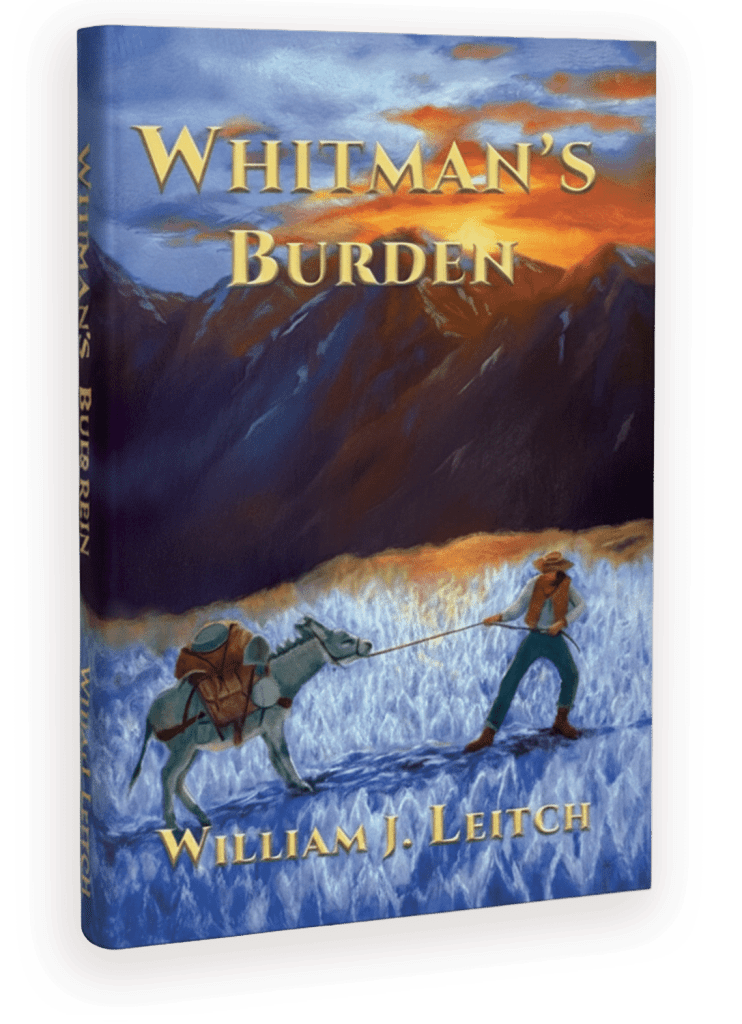
Four years elapsed after my two disastrous pack burro races. I didn’t even get a whiff of a jackass during that time. Entering another pack burro race had not once entered my mind. But this year, with the imminent publication of my first novel, Whitman’s Burden, which stars a burro, I thought “Maybe I should try one more burro race.”
I studied the calendar of Colorado pack burro races. It was already May and many of the races were sold out. The race in Victor had two burros available. Then a phrase jumped off the screen.
“These burros need fast runners who can maintain a 9-minute-mile pace.”
Click.
I got paired with Macho Man of the Beso de Burro Ranch. Macho’s owners (does anyone really own a burro?) Michelle and Steve, told me that Macho loved to run. We arranged a training run two days before the race. In the training run, Macho fell in line behind a lead burro that wanted to walk. But he seemed a little impatient, as was I. Michelle, who was running with Rico Suave, another one of her four burros, and knowing my history of pack burro racing bungles, said, “He’s content to stroll on training runs. But on race day, he’s a different animal. He’s ears back.”
I saw a glimpse of that fire near the end of the four mile trot, when he spotted the trailers at the parking lot. He elbowed (elbowed? Yes, donkeys have elbows and sometimes they throw one) past the teams in front of us. When we reached the parking lot first, I turned to face the other runners coming in, held up my arms, and yelled, “First place!”
Two days later, I was on my way to Victor. I expected traffic and crowds for the Victor Gold Rush Days celebration—the oldest in Colorado. The town has been having an annual celebration for more than 100 years. But when I arrived, there were more tents set up with food and things for sale than there were people walking the streets. It seemed nobody else chose to arrive the night before the burro race and even the locals weren’t out and about. In 1900, Victor’s population was 18,000 souls. Today it is less than 400. “Victor could thrive if it welcomed casinos,” I thought. “And, thank God they don’t have casinos.”
It’s a picturesque Old West mining town in a beautiful Rocky Mountain setting. It seems half of the buildings and homes are empty or for sale or both. I took an evening walk through the side streets. What Victor lacks in prosperity and things to do it makes up for in friendliness. Leadville had some famous lawmen, outlaws, and a few literary greats spend time there. I don’t know if any writers visited Victor, but, as a teenager, Jack Dempsey worked as a mucker in its mines. He fought in mining camp bouts between shifts and trained in the City Hall, a gorgeous building that’s still in use.
I saw the whole town in a half hour walk. I fueled up on delicious pizza at Dirty Sally’s, and chatted with Dirty Sally and the other friendly staff and some patrons who were also running the pack burro race. Time to get some sleep, I walked across the street to the Victor Hotel, another beautiful old structure. I was gasping for breath just walking up the stairs up to my fourth floor room. “Crap,” I thought. “Macho Man is going to chew me up and spit me out.” I had just returned from a month at sea level in Maine and had lost all those surplus red blood cells.
In the morning, I found the Beso de Burro trailer with Macho Man, Rico Suave, Lolita, and Caper. Michelle and Steve were getting all four burros saddled and ready to race. When Macho was ready, we walked to the start line. Sure enough, he was “ears back” just being in the pre-race chaos. I brought him to the front of the pack, right behind a couple of wiry young dudes half my age with their svelte and fleet-looking minis.
BANG! We were off. It was an uphill start and Macho galloped with the burro elite. I saw 6:30 pace on my watch when I risked a glance at it. We covered the first mile in 7:30—did I mention Victor is at 10,000 feet?—and I was either going to let go of the rope, get dragged on my face for the next six miles, or somehow slow down this long-eared, runaway burro.
Until now, slowing a donkey had never been something I’d had to worry about. But Michelle had shown me the technique. Get in front of the burro and hold your arm out in front of him. Or both arms. What could be easier? There was just that one minor detail, “Get in front of the burro.”
I was deep in oxygen debt, at death’s doorstep, ready to drop. Gassed. Spent. Whipped. But now I had to sprint faster than the damn donkey—who probably would take my burst of speed as a challenge to gallop even faster—and then . . . Then what? Get right in front of him and impede his progress? My 145 pounds and two legs against a half-ton, four-legged jackass, whose comfortable pace is about, oh, 4-minutes per mile?!
I had one shot. If I failed, I’d have to let Macho finish the race without me. I managed to get beside his head and hold my right arm out in front of his nose. I’m a gentle guy, so I sweet-talked him. “Macho, for the love of Pete, slow the @#$%^&*%! down!” Well, I’m alive to tell the story because he did. We were still running way too fast for me to maintain over seven hilly miles on rocky terrain at, ahem, 10,000 feet altitude. But I had a burro who at least sporadically humored me.
Until . . . Until we reached a place through high desert scrub where the single track trail took a 90-degree right-hand turn. The lead pack of five burros had made the turn. Macho and I were about 50 yards back, because I was intentionally holding us back. Apparently, even a jackass understands tangents. Macho bolted around my skinny arm obstacle and cut through nasty desert weeds and cactus and over treacherous footing to cut the corner and catch up to the leaders. As I tried to run madly through the wild desert terrain, that was no problem for a burro, it was clear that Macho intended to drop me. “What part of the word ‘race’ do you not understand?” his body language screamed. The rope made smoke as it ripped through my gloved hands. “Don’t cut corners, you jackass!” I snapped, gripping the knot at the end of the rope for dear life, hurdling prickly pears, dodging piñon trees, and dropping F bombs. Macho didn’t give a damn. We were back in the lead pack, and Macho was incentivized to beat the snot out of all those skinny minis with their skinny mini human teammates.
I thought I was going to have to let go, but I held on because I’m stubborn, too, burst past Macho, and got back in front of him. I managed to slow him down with my arm signal. I let Macho trot so my heart rate would return to something survivable. The lead pack slipped away. Macho huffed and seemed to snort in disgust, as if saying, “Fine, you want to walk, Pokey, we’ll walk.”
I saw the rest of the pack strung out in the distance behind us and I thought, “Well, we can get running again. No need to walk and let all those teams pass us.” Macho trotted but soon we got behind a string of about seven teams spread out, all walking. Macho was itching to jog again and so was I. To the guy in front of Macho and me, I called out, “My burro wants to run. If you let us by, he’ll get yours and the others running again.” No response. “Hm,” I thought. “I guess in a race you don’t willingly let anyone pass.”
Finally the trail widened, I encouraged Macho, and we passed that guy and his burro. Sure enough, his burro started jogging in line behind us. Then we repeated this process with two more teams. Macho was leading the way and getting asses running again. On a narrow switchback descent, there was a Conga line of four teams strolling leisurely down the narrow single track. Macho and I were in sync, jogging at 9-minute mile pace, with him right behind me, with a little slack in the rope. I finally managed to bolt past all four of the teams at a switchback and, you guessed it, they all started running. So Macho and I led seven teams at a quick trot down the slope. At one point, the guy behind me yelled, “Hya Macho! Hya!” Normally, that’s an acceptable tactic to get all the burros moving faster. But, not my burro; at least not with me as his running mate. So I hollered over my shoulder, “Macho is running the pace I want him to!”
The seven of us teams stayed more or less together all the way back into Victor. But all the burros were walking. Most of the humans looked spent and content to walk. But not me, and not one young guy. We got our burros running, and the other five teams galloped behind us into town and we made the turn onto Victor Avenue. I wanted to lead us all across the finish line and so did Macho. But we had a race on our hands with another team, and Macho and I were trailing. We raced, each man beside his burro. As the finish line drew nearer, the other runner dropped back and prodded his burro on its rump with the end of the rope. Macho didn’t need any butt slapping from me. He was born to run. He nosed out the competition at the finish line.

We finished 12th, with 13th through 18th within three seconds of us. It was a victory of sorts. I hugged my teammate. I fed him his snacks from his pack. Then I fed him all my own uneaten human snacks. Although Macho was itching to get back to his corral, I made him stay at the finish line and watch his three ranchmates finish: Rico Suave with Michelle, and both Lolita and Caper with first-time burro racers.
Right after the race, I signed up for the Alder Ass Race in South Fork, scheduled for six weeks later. Two weeks later, in Buena Vista, with a teammate from Texas about my age, Macho Man outsprinted three other teams down the homestretch to take the win, besting a field of 64 teams.
After hearing that news, thoughts of the South Fork race made me queasy in my stomach. Yes, I had asked for a burro who could run. But would Macho Man expect me to either podium or be willing to die in the attempt?